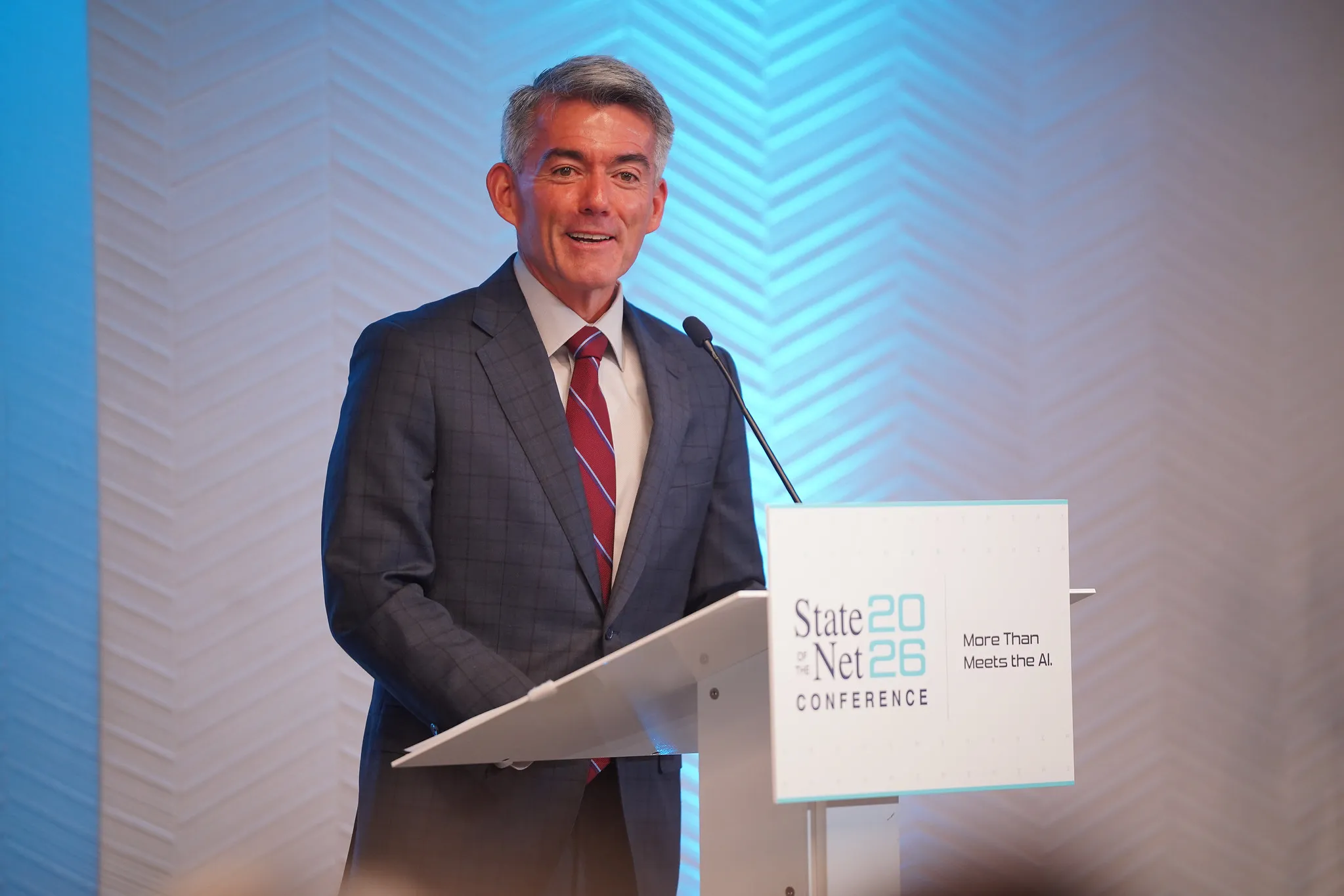
At today’s State of the Net Conference, NCTA President & CEO Cory Gardner delivered a keynote focused on how artificial intelligence is reshaping the economy — and what it will take for the United States to lead in the AI era.
Gardner used the address to introduce CORE AI, a six-part policy framework designed to support innovation while strengthening critical infrastructure, protecting creators, and ensuring consumers and workers benefit from AI’s growth.
A CORE approach to AI policy
First, Gardner emphasized that AI depends on the connectivity infrastructure that underpins it.
“This critical infrastructure isn’t just a byproduct of AI. It is the backbone, the workhorse, the foundational element that made and makes AI possible,” Gardner said, adding that connectivity must be built into national economic and security policy.
That foundation is the result of sustained private investment. NCTA members have invested more than $355 billion in broadband infrastructure over the last 20 years, including $26 billion in 2025 alone, helping deliver faster speeds, broader access, and lower costs for consumers.
Second, Gardner warned that a growing patchwork of state AI laws could undermine innovation and investment.
“Core to AI is the ability to flourish without policy see-saws and whipsaws arbitrarily limiting investment opportunity and connective capability,” he said, urging policymakers to collaborate with industry and avoid fragmented approaches.
Third, Gardner called for continued investment in AI-focused research and development, stressing the importance of coordinated, long-term efforts rather than piecemeal policymaking.
“This work must not be done in siloes,” he said, pointing to opportunities for AI to improve spectrum efficiency, network management, and security — including advances that help meet growing demand for wireless and Wi-Fi connectivity.
Fourth, Gardner made the case that strong copyright protections are essential to AI alignment and innovation.
“Our nation’s flexible fair use doctrine already strikes a careful balance,” he said, arguing that courts should continue their case-by-case approach rather than creating new AI-specific exceptions that could weaken intellectual property protections.
Fifth, Gardner highlighted the importance of workforce development, noting that education, training, and reskilling programs will be critical as AI reshapes jobs across the economy — from network operations to data infrastructure management.
Finally, Gardner stressed the need for a shared national understanding of AI’s power and responsibility.
“To be successful, we must fully develop our approach through a common national understanding, planning, industry engagement and a CORE AI approach,” he said — one that harnesses AI’s transformative potential while addressing its challenges.
AI adoption will continue to accelerate in the years ahead. Gardner’s message at State of the Net was clear: meeting that moment requires policies that are grounded in investment, innovation, and coordination — the core principles behind CORE AI.
To learn more, read the full speech.