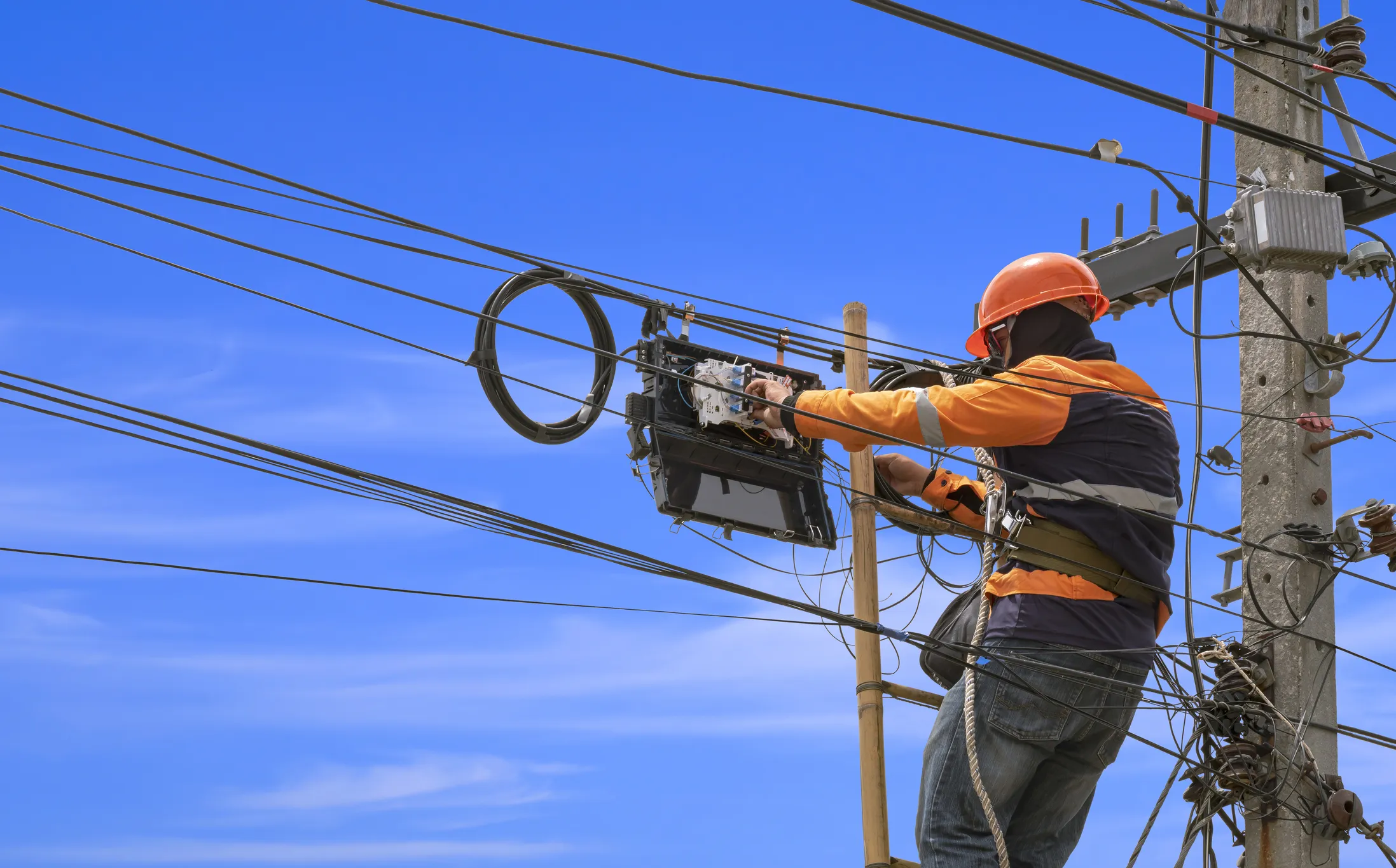
A new study from the Advanced Communications Law and Policy Institute (ACLP) at New York Law School warns that utility poles could cause significant delays and increase costs for BEAD-funded broadband projects.
The BEAD Pole Analysis, published this month by ACLP’s Broadband Expanded project, overlays more than 3.8 million BEAD-funded locations across 2,053 electric utility service territories — providing the most comprehensive picture yet of how pole access could affect one of the largest infrastructure investments in American history. The last time there was a significant investment in our nation’s rural pole infrastructure was during the electrification of rural America, and now, these same poles from 100 years ago stand to expedite or delay the deployment of this century’s technology.
The Scale of the Challenge
Roughly 42% of all BEAD fiber deployment will be aerial, meaning it runs on utility poles. That translates to approximately 188,000 planned aerial route-miles, and an estimated 3.9 million utility-owned poles that BEAD-funded ISPs will need to access to get the job done.
Getting onto those poles isn’t simple. ISPs must navigate a maze of make-ready work, pole engineering reviews, attachment fees, and potential pole replacements, all negotiated with thousands of individual utility companies operating under wildly different regulatory regimes.
Nationally, ACLP estimates total pole-related costs of approximately $1.25 billion. Many factors influence what ISPs actually pay when they touch a pole, including:
- Make-ready and attachment fees, which vary significantly from utility to utility and are often unregulated.
- Pole engineering reviews, which may reveal that there are too few poles spaced too far apart for telecomm services to attach, or that there are preexisting violations from other attachers.
- Replacement costs per pole, which can range from $2,000 to $9,000 or more.
- How many poles need to be replaced, which ACLP models as between 3% and 8% of poles touched.
Notably, the 3.9 million poles that BEAD projects will require touching are currently governed by a patchwork of regulations:
- Only 10% of the utility poles BEAD will touch are subject to FCC regulation. The FCC has jurisdiction over poles owned by investor-owned utilities (IOUs), but only in 27 states, and municipal utilities and electric cooperatives generally are exempt from FCC oversight regardless of state.
- Approximately 40% of all BEAD aerial fiber deployment will occur in electric cooperative service territories, even though cooperatives serve only about 13% of all electric customers nationwide. Because cooperative poles are largely unregulated, ISPs building in these areas have virtually no recourse when costs come in higher than expected.
- Unregulated utilities face few guardrails on what they can charge. A 2018 FCC advisory committee survey found that attachment rates for unregulated entities — cooperatives, municipalities, and public utilities — are significantly higher than those charged by regulated IOUs.
Because pole-related costs can vary greatly from project to project, utility companies may not be able to cover repair/replacement costs and thus have an interest in shifting as many costs to ISPs as possible. These uncertain pole costs may significantly increase construction costs for BEAD projects. In addition, the time it takes to resolve pole disagreements can oftentimes delay or derail broadband deployment projects.
Disputes in Practice
Pole access challenges are not uncommon. The ACLP report notes that broadband deployment history includes numerous examples of ISPs encountering higher-than-expected pole costs even after negotiating in good faith — in some cases, enough to make grant-funded projects financially unviable.
Recent regulatory action by the FCC has helped bring some clarity. Earlier this year, the Commission found that a major Virginia utility had attempted to bill a broadband provider for replacing poles that already had pre-existing code violations — costs the ISP did not cause and should not bear. The FCC ruled that such cost-shifting violates its rules.
That ruling reaffirmed established precedent, but disputes continue. With BEAD projects now getting underway, consistent enforcement will be critical.
What Needs to Happen
NCTA agrees with several of ACLP’s proposed solutions, including:
- Federal legislative reform to give the FCC a clearer and broader mandate over pole access — especially for cooperatives and municipal utilities.
- Continue strong FCC enforcement, including swift resolution of pole attachment disputes through the recently established Rapid Broadband Assessment Team (RBAT), which has already been effective in moving quickly to ensure that delays don’t cascade into project defaults.
- Flexibility from NTIA to allow states to use a portion of the remaining $21 billion in BEAD funds to offset unexpected pole-related costs. A well-designed program — modeled on successful state-level efforts in Texas and North Carolina — could provide subgrantees a meaningful safety net.
Through recent actions, both NTIA and the FCC have been moving in the right direction on these issues. But continued vigilance is warranted, as it is clear that some utilities still do not have the sense of urgency and collaboration needed for BEAD to succeed.
The Bottom Line
BEAD represents a significant federal investment in connecting unserved communities. The regulatory patchwork governing utility poles introduces meaningful cost uncertainty for subgrantees that can delay or derail projects.
ACLP’s analysis underscores why policymakers should prioritize pole reform as BEAD deployment gets underway. Addressing cost predictability now, before overruns accumulate, is the most direct way to ensure federal broadband dollars reach the communities they were intended to serve.