Hurricane season is upon us, and out west, wildfire risk remains elevated. For the cable industry, readiness isn’t a seasonal scramble. It’s a year-round operation built long before a storm forms or a fire ignites.
Here’s a look at how member companies prepare networks, crews, and communities to stay connected when it matters most.
Preparation Never Stops
Providers monitor conditions and invest in backup infrastructure well ahead of any disaster:
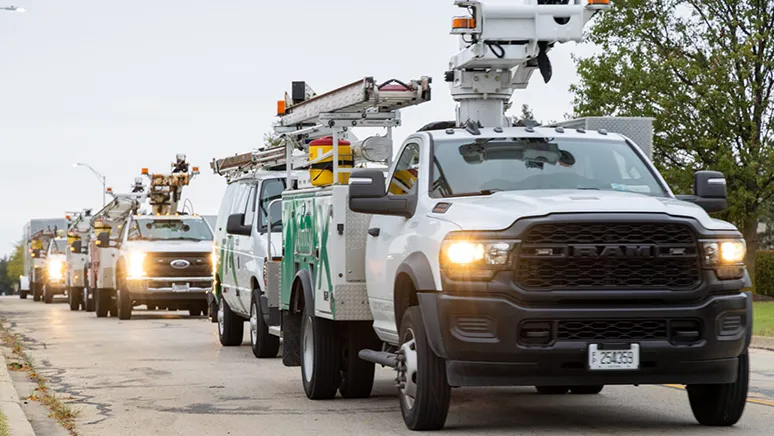
- Midco’s Network Operations Center puts storm-threatened service areas into “disaster mode” ahead of landfall, monitoring the network around the clock and switching customers to backup fiber where possible. Field teams pre-position storm-ready vehicles and rely on local contractor partnerships to scale up quickly when damage exceeds a single crew’s capacity.
- Comcast builds AI directly into its network for real-time visibility into performance, helping crews prioritize restoration work during extreme weather. It’s also the first provider to offer a back-up connectivity device with its Pro WiFi Extender + Battery Backup, a WiFi extender with a rechargeable battery and cellular backup that automatically keeps homes connected through power outages.
- Spectrum offers Invincible WiFi, which pairs WiFi 7 with up to eight hours of battery life and automatic 5G cellular backup so customers can stay connected when the power goes out.
- GCI, Alaska’s largest telecom provider, maintains a dedicated 155-person rural crew and a statewide Service Management Center that monitors network performance year-round.
- During a historic 2022 flood event in Western Alaska, GCI’s network held largely intact despite two communities being temporarily cut off, a result the company credited to advance planning and pre-positioned crews.
Partnership Powers Recovery
Because broadband and power infrastructure often share the same poles and pathways, restoration depends on coordination across sectors. Centralized command centers bring together utilities, local officials, first responders, and broadband crews to prioritize repairs and avoid duplicated work in the aftermath of hurricanes, wildfires, and other major storms.
Rapid Response and Restoration
Once it’s safe to move, crews and equipment mobilize fast:
- Spectrum’s Regional Operations Centers monitor conditions around the clock to pinpoint impacted areas so repair teams can deploy as soon as it’s safe.
- Following Hurricanes Helene and Milton, the 2025 Los Angeles wildfires, recent tornados, flooding and storms in the Midwest and Texas, as well as August’s Hurricane Lala in Hawaii, Spectrum opened more than 170,000 WiFi access points and deployed WiFi trailers to provide connectivity to impacted communities.
- Comcast teams work year-round to maintain and fortify their network against weather-related disruptions and open free public Xfinity hotspots to help communities stay connected when disaster strikes. Comcast has also donated millions to relief funds to help impacted communities rebuild.
- Comcast opened more than 11,000 public Xfinity WiFi hotspots for residents and first responders during the 2026 Spokane wildfires. For Hurricanes Helene and Milton, Xfinity opened more than 500,000 WiFi hotspots to the public to remain connected for free.
- Mediacom deploys mobile WiFi trailers to impacted communities and opens public hotspots so residents can stay connected while service is restored.
- During Hurricane Helene, Mediacom placed WiFi trailers throughout Valdosta, Georgia, for free public use and restored service to over 18,000 customers as crews regained access and commercial power came back online.
- GCI combines around-the-clock network monitoring with locally based technicians and backup infrastructure to quickly assess damage and restore connectivity across Alaska’s remote communities.
- After Typhoon Halong struck Western Alaska, GCI crews worked to restore service and assess damage while the company provided generators, phone chargers, account credits, and other support to impacted communities.
Across the industry, the pattern holds: prepare through the calm, coordinate across sectors when disaster hits, and move fast to restore the connections communities depend on for safety and recovery.
Go Behind the Scenes with “After the Storm”
NCTA’s docufilm “After the Storm” takes viewers behind the scenes with broadband crews working alongside utilities and government agencies in the aftermath of Hurricane Helene, the Palisades Fire, and Hurricane Milton.
Filmed on location in Asheville, North Carolina; Los Angeles, California; and St. Petersburg, Florida, the film follows crews navigating dangerous terrain and damaged infrastructure to bring communities back online, underscoring how deeply broadband and power networks are intertwined, and how much coordination it takes to restore both.
Watch the film below.