
From CableLabs: Cable's Role in Cybersecurity
Originally published on CableLabs.com by Mark Walker, Director of Technology Policy at CableLabs on October 18th, 2017. The cable industry does more than just provide internet connectivity for millions of customers: it also plays an active role in driving security in the broader internet ecosystem. Cable operators have a long history of successfully defending against attackers seeking to steal service, customer data and video content. The cable industry has been protecting the delivery of high-value video content for over 30 years through technology that has never been breached in a successful
Learn About Cybersecurity & Staying Safe Online

October may be known as the month for pumpkins and Halloween costumes, but did you know that it's also National Cybersecurity Awareness Month? As our lives intersect with and depend more and more on the internet, this month is a good time to step back and educate ourselves about the various schemes out there–whether they be viruses, spyware, botnets, identify theft, spam or phishing programs–that not only stand to impede our online experiences, but to encroach on our privacy and disrupt our lives. For a bit of background, National Cybersecurity Awareness Month started in October 2004 and
Our Comments to the FCC on Restoring Internet Freedom

Yesterday, NCTA submitted comments to the FCC in its docket on Restoring Internet Freedom. The comments reaffirm NCTA’s longstanding commitment to core open internet principles that ensure that all consumers can enjoy free and unimpeded access to the lawful internet content of their choosing. Those core principles, which have evolved from the four internet freedoms first articulated by then-FCC Chairman Michael Powell in 2004, ensure transparency, no blocking, no throttling, and no anticompetitive paid prioritization – all of which have been consistently embraced and adhered to by NCTA and its
Collaborating Across the Entire Internet Ecosystem to Defeat Botnets
A May 2017 executive order – Strengthening the Cybersecurity of Federal Networks and Critical Infrastructure – tasked the Departments of Commerce and Homeland Security to lead an open and transparent process to identify ways to improve the resilience of the internet and communications ecosystem, and reduce threats perpetuated by botnets, particularly distributed denial of service (DDOS) attacks. In support of this order, both the National Telecommunications and Information Agency (NTIA) and the National Institute of Standards and Technology (NIST) are soliciting public input. Last week NIST
What We All Share on the Day of Action

Tomorrow, a number of internet companies and net neutrality interest groups are participating in a highly publicized “Day of Action”. This was organized in reaction to the FCC proceeding that proposes to reverse the former FCC’s decision to impose heavy internet regulations (Title II) on network providers and return to the highly successful light-touch regulatory structure (Title I) that governed the internet for decades. In the opinion of the Day of Action organizers, reversing Title II threatens the net neutrality principles that today govern the internet; namely, that internet providers
ISPs Commit To An Open Internet

Recently, member companies of Broadband for America placed a full-page ad in the Washington Post to reaffirm our strong commitment to an open internet and to delivering a fast and vibrant online experience to consumers.
Dear Harold Feld

Last week, Harold Feld published a blog on the Public Knowledge website called “NCTA Proves Virtuous Cycle Works.” Since it isn’t every day that Feld (or PK) agrees we’ve proven anything, I decided to check it out. Let me start by commending Feld for acknowledging what many other advocates willfully ignore: broadband in America has continuously gotten better and faster over the past two decades while providing consumers more bang for their buck. Feld even cites with approval an NCTA blog post quantifying the ever-increasing U.S. broadband speeds and the fact that consumer prices have fallen
NCTA President & CEO Michael Powell Talks Open Internet and Regulation on CNBC
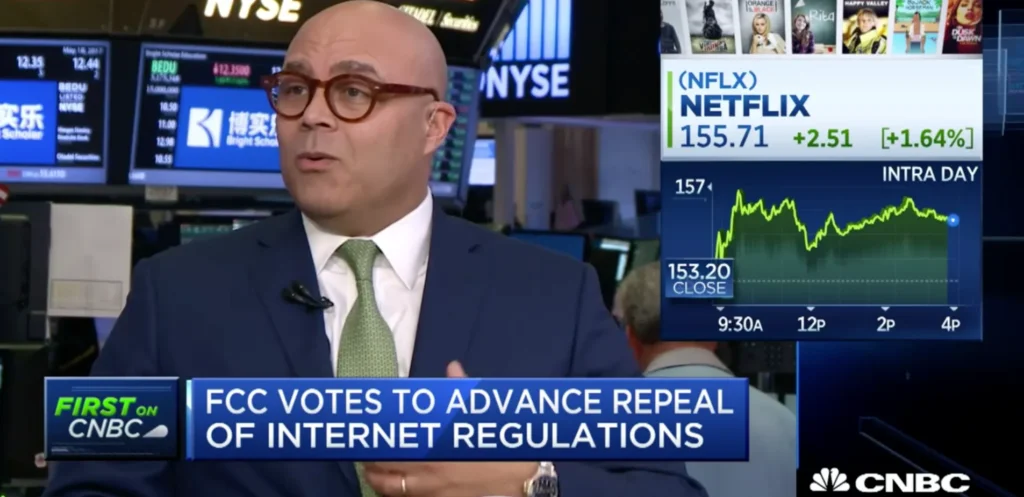
Following Thursday’s FCC vote to advance the Restoring Internet Freedom rule proposal, NCTA President & CEO Michael Powell appeared on CNBC to discuss what those changes could mean. As we’ve stated, our industry supports a free and open internet, and Powell explains how light touch regulation benefits both consumers and network providers. Click on the image below to see the video.
Reaffirming Our Commitment to an Open Internet

Tomorrow, the FCC will begin the latest chapter in what is now a decades-long debate about the appropriate regulatory framework for the modern internet. One of the many things that this raging debate obscures is that there is substantial agreement on basic principles of behavior that promote an open Internet experience for consumers. In general, consumers are and should be in charge of the internet experience. So long as their conduct is lawful and subject to a provider’s reasonable network management, internet users should have the freedom to go anywhere on the internet or to run any
Bipartisan Consensus is "Light Touch" the Right Approach for Internet Regulation

Another battle in the decade-long saga over internet regulation has erupted in Washington. After spending so much time with these issues, it can be hard for us to remove ourselves from the daily skirmishes, and listen to what actual consumers think about these issues. That is why NCTA conducted a survey with Morning Consult to take the consumer temperature on the issue of internet regulation. And while politics may be as divided as ever in our country, consumers share a strong bipartisan consensus that the government should let the internet flourish without imposing burdensome regulations. The