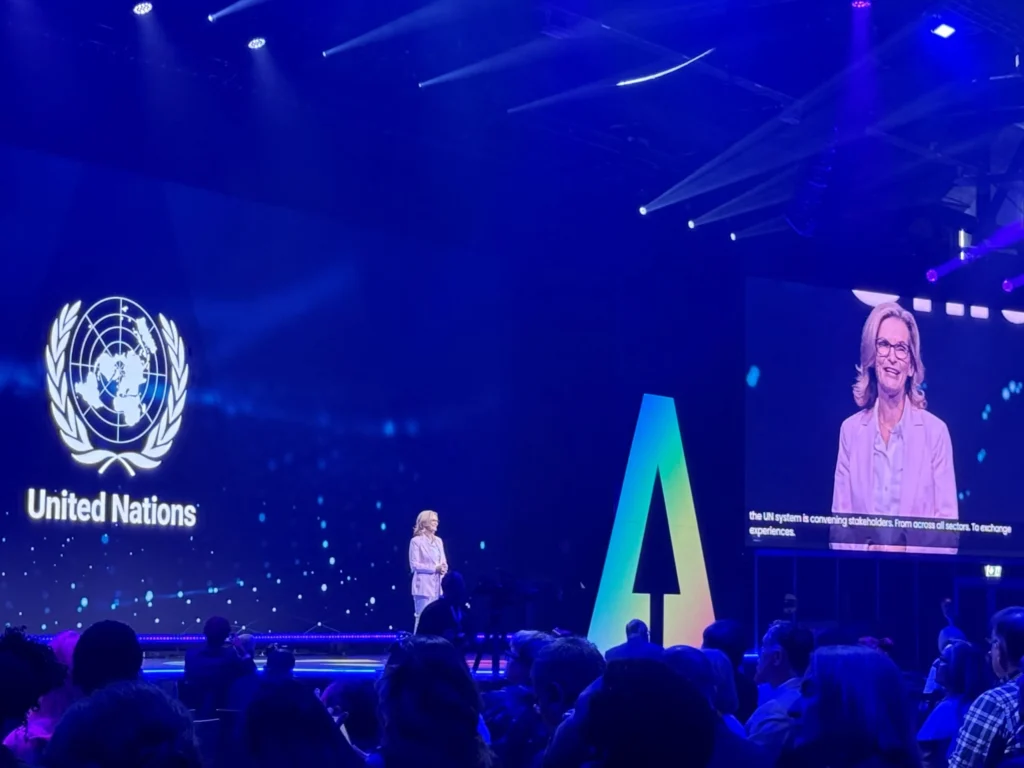
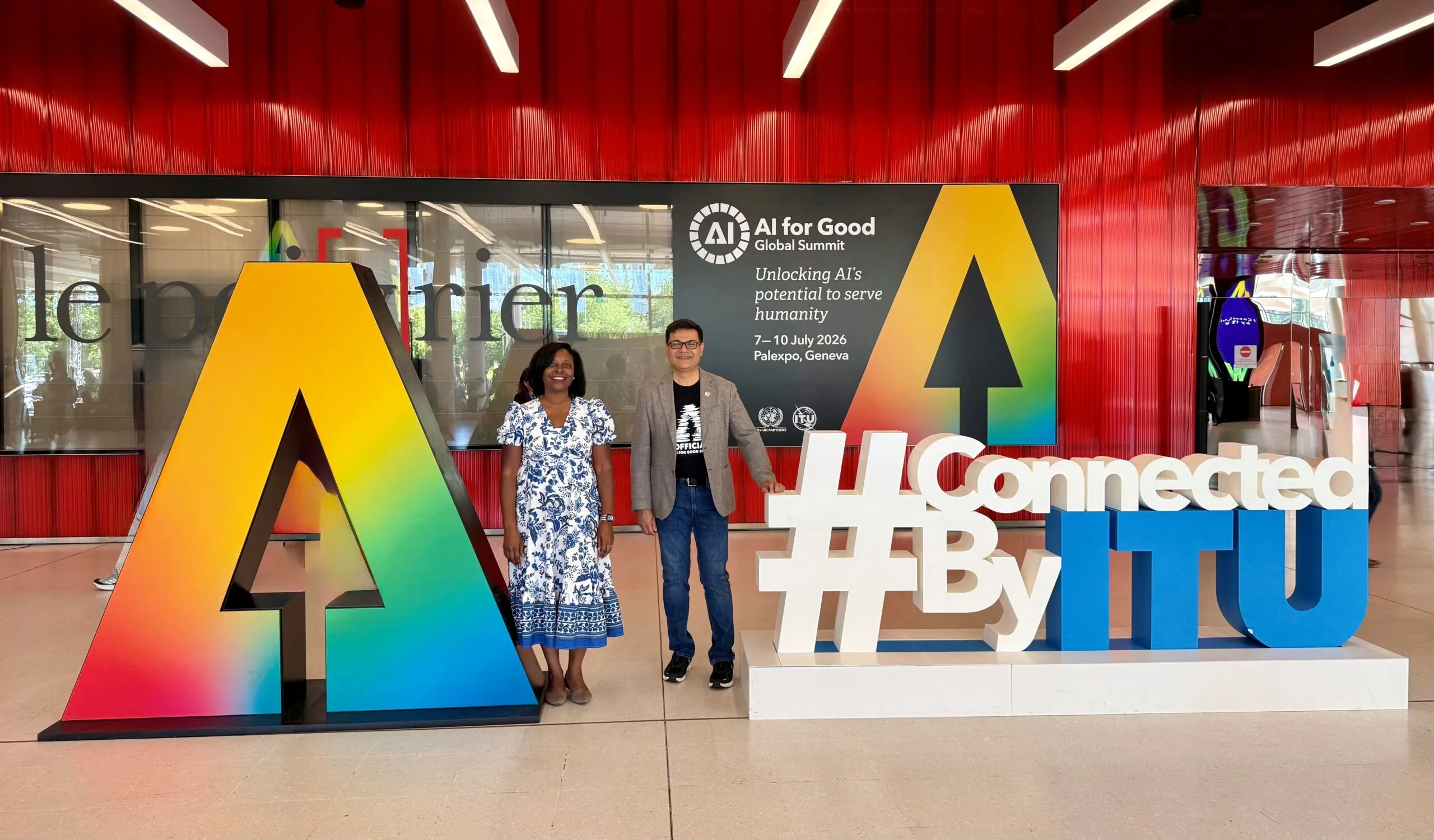
Early July brought an unprecedented convergence of international AI conversations to Geneva, Switzerland. Over the course of a single week, three major gatherings, the inaugural UN Global Dialogue on AI Governance, the International Telecommunication Union’s (ITU) AI for Good Global Summit, and the ITU’s World Summit on the information Society (WSIS) Forum, brought together governments, international organizations, industry, and civil society to advance multistakeholder collaboration to tackle the safe, inclusive and equitable development of artificial intelligence.
NCTA’s Rikin Thakker, Ph.D., Chief Technology Officer, and Traci Biswese, Vice President & Associate General Counsel for National Security & Emerging Technologies, represented NCTA and participated in discussions throughout the week. Between plenary sessions, technical briefings and invitation-only roundtables, a few themes emerged that matter for the broadband and communications industry.
Communications Infrastructure is AI Infrastructure
Across nearly every session, the conversation moved beyond “using AI” to what it takes to build and operate AI at scale. Compute, connectivity, data infrastructure, and energy were repeatedly framed as strategic national assets, with communications networks emerging as a foundational – though often underappreciated – layer of the AI ecosystem.
Several sessions explored what it means for networks to become “AI-native,” with AI increasingly embedded in network planning, operations, orchestration, and optimization rather than simply layered on as an application. At the same time, speakers emphasized the importance of ensuring that developing countries can help build and shape the AI ecosystem, not just consume services developed elsewhere.
The rise of Edge AI further reinforced this trend. Many real-world AI applications – from industrial automation to connected infrastructure – cannot rely exclusively on cloud computing because of latency, bandwidth, privacy, resilience, or energy constraints. As AI workloads become increasingly distributed across cloud, edge, and connected devices, broadband connectivity and low-latency networking become integral to AI system design. Successful Edge AI deployments require careful trade-offs among compute, communications, security, and power consumption.
Spectrum is Entering the AI Conversation
Communications infrastructure and spectrum policy are increasingly becoming part of broader AI infrastructure discussions. During an invitation-only roundtable on digital trust and AI infrastructure, NTIA Administrator Arielle Roth spoke about taking a holistic view of spectrum policy as part of the nation’s broader AI and digital infrastructure strategy, explicitly recognizing the role of both licensed and unlicensed spectrum, including Wi-Fi. ITU Secretary-General Doreen Bogdan-Martin likewise pointed to trusted digital identity and common standards as essential as AI agents take on a larger role in critical infrastructure.
Digital Trust is Evolving for an Agentic World
As AI systems increasingly interact with each other, not just with people, questions of identity, authentication, consent and accountability took on new urgency. Multiple sessions noted that today’s internet trust mechanisms were designed for humans, not autonomous AI agents, and that interoperable standards will be needed to keep pace. The ITU used the week to launch a new Focus Group on Trust and Identity for Humans and AI Agents, a sign of how quickly this issue is moving from theoretical to operational.
Standards Over a Single Rulebook
Rather than pushing for one global AI governance framework, speakers largely coalesced around a different goal: practical interoperability across different national approaches. Egypt shared how it operationalized its AI strategy using ISO standards and procurement checklists. The UK emphasized interoperability over uniformity. Several speakers also warned against “governance washing,” where impact assessments become paperwork rather than tools that actually shape how systems are built. The refrain throughout the week was “governing by design or being governed by default.”
Quantum Security is the Next Major Technology Transition
Beyond generative AI, quantum came up as its own strategic priority. Sessions on quantum networking, quantum key distribution and post-quantum cryptography consistently urged organizations to accelerate migration to post-quantum standards now, while continuing to explore where quantum networking can complement existing security architectures.
AI Sovereignty Extends Beyond Compute
AI sovereignty, a nation’s ability to independently develop, deploy, regulate, and secure its AI capabilities, emerged as a recurring theme throughout the week. Speakers described four interconnected pillars of AI sovereignty: compute, models, data, and governance. While compute often receives the greatest attention, discussions consistently emphasized that communications infrastructure underpins all four pillars by connecting users, cloud platforms, edge systems, and AI services.
Looking Ahead
A clear theme ran through the week: broadband infrastructure, and Wi-Fi in particular, remains underrepresented in global AI conversations that tend to focus on models, governance and compute. As AI applications become more real-time, interactive and agentic, low-latency connectivity will only grow more critical to how those applications actually perform.
More broadly, the week reinforced that many of the issues at the center of the global AI conversation, cybersecurity, post-quantum readiness, spectrum policy, broadband infrastructure and trusted networks, are the same ones shaping the future of connectivity here at home. The next UN Global Dialogue on AI Governance is set for New York next May, and the conversations from Geneva are likely to carry forward into that discussion.